| |
Bitches
brew, one and two.. |
Mike's
bitchin' guitars
Bitch
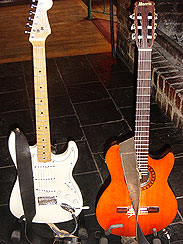
1) A Japanese made Fender Stratocaster
guitar built
in late 1984,
the original pick ups have long since
been replaced with Kinman Trad. AVn's.
It's been maintained and modified
over the years by Brenden Mason at
Real Guitars, including flattening
out the original alarmingly rounded
fretboard. Tony Brittenden checked
out the serial number to determine
its age and discovered it's exactly
the same age as his daughter, Rowan,
so these
days she
answers to the name Ro. (Ro
means heron in Japanese).
I use D'Addario eXL 140 strings.
Bitch
2) My 'other' guitar is a Morris
(Groovin’ Power Acoustic) guitar,
which is a solid body nylon-string
guitar also made in Japan. I thought
Morris had ceased trading, but apparently
it's re-emerged recently, although
I suspect this particular model has
been discontinued. Its output used
to be exceptionally low, but Brenden's
managed to boost it considerably.
Due to its solid body it's unaffected
by feedback-type overtones. I use
D'Addario Pro Arté normal tension
strings |
|
|
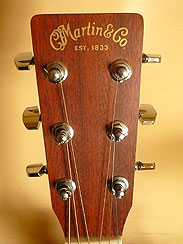
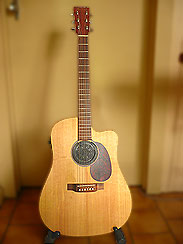
1)
The classic Martin head stock 2) Gorgeous
George Martin |
George
Martin
I've
always wanted to own a Martin guitar,
well, since our 2000 visit to San
Francisco anyway, so when I had the
opportunity I went ahead and bought
one. I couldn't afford the top of
the range, so I bought the DCXIRE
model with the Fishman prefix. I figured
I'd be mostly playing it amplified
so I've got the lightest strings on
possible (with the mandatory wound
third) so it feels like an
electric to play. I thought I'd be
writing a swag of strumming songs,
but that hasn't happened yet. When
I do my solo gigs it's with George
and my Jam Man pedal. Current strings
- a confection of Martin and Ernie
Ball's - 10, 14, 20, 30, 42, 52. Jury's
still out on these although the tensions
are right..
|
|
|
 |
Mike's
amp
The
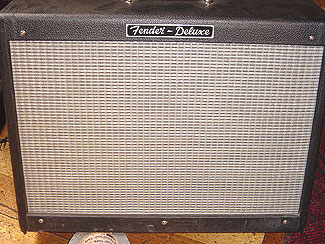
Fender “Hot-Rod” Deluxe
40w-RMS guitar amp. B-Type, combination
tubes and digital. A powerful and
pretty flexible amp with just the
one 12" speaker. It's not as
detailed as the sister amp, the Blues
Deville, which has four 10" speakers.
A drawback with the Deluxe is that
both channels share the same tonal
circuitry, so I've by-passed the distortion
channel (which only sounds great at
one specific volume) in favour of
the Boss Blues Driver pedal.
|
|
|
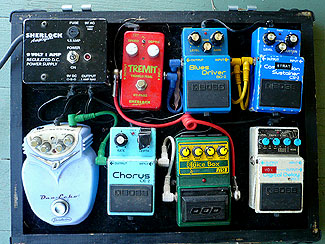 |
Mike's
pedalboard
The
pedalboard was devised and constructed
for me by Dale
Sherlock, who also supplied
the power supply and the Tremit. It
has a useful feature in that the pedals
are held in place with velcro, which
allows me the flexiblility to swap
the pedals around at least once if
I get bored. Going clockwise from
the top left: 1) Sherlock Regulated
Power Supply 2) Sherlock Tremit, which
duplicates the Fender tremolo 3) Boss
Blues Driver 4) Boss CS-2 compression
(signal boost) 5) Danelectro Dan-Echo
6) Boss Chorus CE-2 7) DOD Juice Box
FX 51 8) Boss Digital Delay DD-2 for
my vocal mic, so I have to de-earth
my guitar amp |
|
|
| |
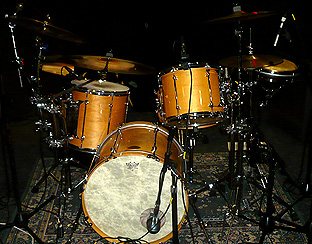
|
Robbo's
drums
Robbo's
kit was made for him by Paul Barter
at Barter
Drums, now located in Tasmania.
It consists of a 5.5" snare drum
(now with POP maple hoops), a
12" mounted tom, a 14" floor
tom and a 20" bass drum,
plus a Pearl
travel conga and a djembe. When he's
in the mood he'll use his quinto and
conga or his Korg Wavedrum. He has
the usual selection of ride, splash
and crash cymbals, plus a China and
sizzle.
Robbo has got a cute white Gretsch
kit as well for the smaller gigs |
| |
|
|
| |
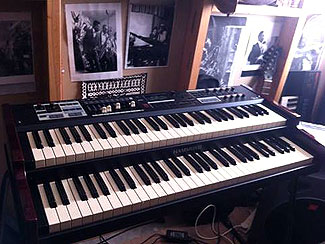 |
Daryl's
keys and amplification
Daz is now the proud owner of a Hammond
SK2 as well as his Roland A90 keyboard
+ sustain pedal. Amplification is
an Eon powered speaker plus .
Behringer 6 x channel mixer and Roland
10 x band graphic EQ. We're still
waiting for the Leslie.
|
|
|
| |
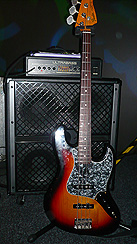 |
Broc's
stuff
A sunburst Fender
Jazz Bass guitar, an Eden Traveller
550 bass amplifier (when it's working)
and a Laney NX410 speaker cabinet
- with wheels. He's got a bevy of
guitars for the Mick & Broc duo
which I'll run through with you as
well - eventually.
|
|
|
| |
| |
The
PA
Behringer
mixer XENYX 1204 FX JBL 2 x EON 15P/230
Powered Speakers Shure
58s Quik
Lok S-173 spkr stands
|
|
|
| |
|
|

