| |
|
|
| |
A
personal background to the music downloads
issue
My
involvement with the issue of free music downloads
began in 2002 when I was asked by Allan Klepfisz
to be Artist Spokesperson for QTrax
(QTrax is 'peer-to-peer' downloading software
that enables consumers to download shared
music and other files at no fee). I had no
idea what that might entail, but after Allan
had explained that he felt that copyright
should - and could - be returned to the composer
even in this rather unpromising scenario,
I agreed. The following is a brief resumé
of events so far in my brilliant, but sporadic
career as Artist Spokesperson for QTrax..
PS - It's taken a while, but Allan's persistence
is starting to pay off. Read about the deals
QTrax - now re-branded Brilliant Technologies
- has pulled off with EMI
Music
and EMI
Publishing (Aug. '06). And, for
an even more dazzling announcement (June '07),
read this from the New
York Post
As reported in January's Stop Press, the
big QTrax launch at MIDEM has been and gone,
but with, at best, inconclusive results. Read
the LA
Times report.. More recent (June
'08) news about QTrax from Silicon
Alley Insider
NB - Some of the links below are pretty
old and may have passed their use by date. |
|
| |
| My
involvement with QTrax -
Mike talks the talk
In June of last year,
I flew to Sydney with three senior executives
from the Singwell International / Qtrax
organisation to meet with representatives
from APRA (Australasian Performing Right
Association), to discuss a ground-breaking
experimental agreement, which would see
revenues generated from (free) music downloads
using Qtrax software returned as royalties
to the composers per APRA.
At the time, the mood for such an agreement
seemed positive, and, with APRA’s
blessing, it was decided to take the message
of the impending agreeement and spread it
to the Asian market via interviews with
CNBC in Singapore and CNN in Hong Kong.
Just a few weeks later I found myself on
a plane with my manager, Jenny Klepfisz,
her husband, Allan Klepfisz, (CEO of LTD
Network), QTrax publicist Deborah Grey,
and Chai Ong, Singwell financial advisor.
I have to say I was more than slightly trepidatious
about being interviewed on a subject I could
only speak lucidly on for about 15 seconds
– and heaven forbid I was asked a
technical question - but Allan and Deb assured
me that I could, and would, be coached thoroughly
on the subject so that I could pass as a
competent interviewee. So, whenever the
opportunity arose, I listened attentively
to Allan on the frequent occasions he launched
forth in his impassioned and articulate
fashion on the subject, and soon began to
pick up a pattern I thought I could follow.
My first interview was with a Singapore
newspaper, the Straits Times, and thankfully
Allan did most of the talking. The article
duly came out the next day with an alluring
shot of Kylie
Minogue as the hook, and all of
Allan’s quotes attributed to me, making
me sound quite knowledgable.
I was then taken to CNBC for my first solo
TV interview. It seemed to go OK, and I
apparently managed to look calm and collected,
even though I was churning inside. It’s
so different talking in front of a TV camera
without an audience or band to bounce off
and a guitar to hold on to.
Then, on to Honkers, and a very different
atmosphere; for instance, English is aggressively
being replaced with Mandarin in conversation
and signage, and there’s little of
the consideration shown to tourists as in
Singapore.
I talked to a local computer magazine journo
called 'Maverick' at some length about the
QTrax software, (Allan again filled in the
technical details, much to my relief) but
it turned out that Maverick had lived in
Melbourne in his student days and was very
keen to talk about the skiing - one of the
few sports in which I have no interest at
all. His dubious sexuality and softly spoken
Hong Kong English made the interview quite
a strain - although Allan later triumphantly
produced a copy of the magazine replete
with the interview (in Mandarin of course!).
The highlight of the visit was to be an
interview that evening on Star TV, but we
had a radio interview at RTHK 3 in Kowloon
in the afternoon with Natalie Haughton as
a warm-up. As it turned out, Natalie was
as smart as she was charming, and although
she knew nothing of the technicalities of
the subject, I felt rather nervous when
we ventured into areas I was quite uncertain
about. |
|


|
|
|
| Top
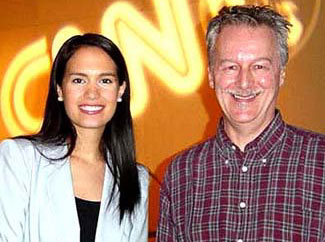
L - R... 1) The mysterious
Maverick 2) Hong Kong Radio
3's Natalie Haughton and
me 3) CNN's Kristie Lu Stout
and a beaming DIY Mike |
|
|
|
|
| The
much anticipated interview on Star
TV was something else again. Admittedly,
we left a little late to get to the studio.
Well, the whole party had to go, and this
meant taking two taxis. Two taxis in rush
hour, and our taxi driver could barely speak
English. And it turned out he didn’t
know his way round Kowloon either, so he
took us to the Kowloon taxi rank and dumped
us. The driver in the next taxi we boarded
couldn’t speak English at all, but
by now it was so late we couldn’t
turn back. Allan called Chai in the other
taxi and got him to speak Cantonese to our
driver, with only the faintest notion if
we were headed in the right direction.
I don’t know how we did it, but we
got there, and with only minutes to spare
I was bundled into the studio and interrogated
by a cheerful Indian-Australian expat in
front of an audience of some 24 million!
We had a slap-up meal that night on the
mountain ridge overlooking Hong Kong, but
I was so shaken by the evening’s experience
I couldn’t really enjoy the meal.
The next day we went to CNN and I did an
interview with the lankily attractive Kristie
Lu Stout on the issues of free downloading
and music piracy, which is somewhat of a
bigger problem in Hong Kong and Asia in
general. With any luck,* you'll be able
to check
out the interview - it gives a
concise overview of the situation as it
was then, and pretty much still is now.
(*This is an enormous file - if you don't
have cable you should find something else
to do for half an hour..)
When we got back to Australia, we discovered
that APRA had decided not to go ahead with
the agreement. Allan’s resolve wasn’t
shaken – in fact, he determined to
take his idea to the US, and talk to some
movers and shakers in the music industry,
as well as APRA affiliates BMI and ASCAP.
Over the past six months or so he's done
just that, and with some very interesting
results. Watch this website for a pivotal
announcement -coming soon! |
|
| What
happens to copyright when the downloads
are free?
Until today, software companies such as
Kazaa, Morpheus
etc.that facilitate free music downloads
for a generation of music consumers, have
not paid a cent to the originators of the
copyright.
The major record companies have uniformly
rejected the concept of free music downloads
and have tried to first ignore it, then
crush it, then buy it out (e.g.
BMG and Napster), and now they’re
moving to legislate
against it, with rhetoric achingly reminiscent
of the impotent copyright warnings you see
on your rented videos. (Interestingly, the
movie studios have just begun a US-wide
campaign against downloading movies from
the Internet).
In the meantime, a large section of the
youth market, the very market the major
record companies feel the need to concentrate
on, is turning its back on the industry
and gutting sales of the latest hit songs
by downloading and burning them onto their
own personalised CDs.
Music artists themselves are divided over
the ethics of free music downloads. Janis
Ian wrote a famous open letter
(and an equally famous follow-up)
to the record industry in favour of the
principle of free downloads a year or so
back, and other popular recording artists
have spoken out in its defence, even the
befuddled Michael Jackson. Equally, there
are other artists who support the record
industry position (see the Laura
Holson article) and it’s
true to say that the issue of copyright
in general is generating much interest and
discussion – and passion.
There is a growing body of opinion within
the record industry that the major record
companies might be better advised to accept
the reality of free downloads and to see
where they might learn, and perhaps benefit,
from it.
As we all know, failure to adapt leads inevitably
to extinction, but the signs are that the
recording industry as a whole, once inextricably
identified with youth and vigour, now seems
unwilling to heed the portents and shift
with the times.
In the meantime, the peer-to-peer downloading
scene is evolving daily. Microsoft is now
offering P2P tools on its latest versions
of Windows
XP and Amazon offers a free music download
service with the emphasis on sampling new
artists. And, perhaps most significantly,
Apple started a service in April (available
exclusively to Mac users and from an initially
modest repertoire) with high audio quality
tracks (comparable to CD quality apparently)
available to download for ninety-nine cents
each.
While proving there are people out there
who want to do the right thing, the fundamental
issue cannot be avoided – namely,
there is a generation of music consumers
out there that has never paid for music
on-line, and, despite all the predictions
(i.e. indifferent quality wouild
drive them back to the fold) without some
sort of inducement, it probably never will.
(See 'The
Empire strikes back' for accommodating
shifts in recording industry policy).
The issue of copyright is at a very interesting,
if not crucial, stage. That the issue has
reached the proportions it has can be attributed
in large part to the initial lack of response
from the industry/industries, and subsequent
negative, and even malevolent, reactions
through the American courts.
I suspect that somewhere along the line
there’s going to have to be a concession
by all the ‘legtimate’ players
that there is another player in the market
and it’s not going to go away. The
sooner this enfant terrible is
accommodated, the better it’s going
to be for everybody.
The signs are that conspicuous success in
the music and movie business is ultimately
going to have to be scaled down. I don’t
think this is necessarily a bad thing; there’s
nothing more embarrassing than a millionaire
musician trying to maintain street cred
with one eye on the stock market.
Mike
Rudd |
|
| Artists
Fight Music File-Sharing
-
Laura
M. Holson Sept. 2002
WHEN it comes to musical styles,
Britney Spears, Luciano Pavarotti and Sean
Combs, lately known as P. Diddy, do not
appear to have much in common. But in a
series of advertisements that begin running
today, they are joining with 86 other recording
artists to speak out against unauthorized
music file-sharing, claiming it threatens
the livelihood of everyone from recording
artists and writers to sound engineers and
record-store clerks.
"Would you go into a CD store and steal
a CD?" asks Ms. Spears in one commercial
to be shown in coming weeks. "It's
the exact same thing, so why do it?"
In a print ad, Shakira, the hip-swiveling
Latin pop star, urges the public to just
"Say no to piracy." And Mr. Combs
— in a statement released by the Recording
Industry Association of America, which is
largely financing the multimillion-dollar
campaign — pleads with consumers to
"Put yourself in our shoes!"
The new campaign, which officially runs
under the auspices of a coalition of music
professionals called Music United for Strong
Internet Copyright, was developed by Amster
Yard, a division of the IPG Sports and Entertainment
Group, which also represents the Recording
Industry Association of America. It comes
at a difficult time for the recording industry.
Sales of CD's fell nearly 7 percent during
the first half of this year, largely, the
industry claims, because of Internet piracy
and file-sharing.
The campaign breaks the same day as the
House of Representatives Subcommittee on
Courts, the Internet and Intellectual Property
begins hearings on piracy and the Internet.
The recording industry has long been criticized
for failing to assuage disillusioned consumers
who want cheaper and more accessible music
over the Internet. The Department of Justice,
meanwhile, is investigating whether the
paid on-line music sites developed by the
record labels violate antitrust provisions
by hampering smaller competitors.
The recording industry, too, has been criticized
by artist rights groups, who complain that
the industry's accounting rules favor the
labels and that the standard seven-year
recording contract is akin to indentured
servitude. On Tuesday, in fact, representatives
of the Recording Artists Coalition, which
include the former Eagles singer Don Henley
who is not included in the new campaign,
were at a California State Senate hearing
testifying about the industry's accounting
practices. But mutual interests have brought
them together for this campaign against
file-swapping.
What will be interesting to watch, industry
executives say, is whether consumers are
alienated by a campaign that speaks of the
travails of wealthy artists like Mr. Combs,
who has some fans who are hard pressed to
afford not only his shoes but also the suits
and jackets he sells under his Sean John
clothing line.
"This is not a campaign created to
engender sympathy," said Hilary Rosen,
chief executive of the Recording Industry
Association of America. "We are saying
there is a significant problem and it is
affecting us and it is illegal."
David Munns, the vice chairman of EMI Recorded
Music, added, "There is a whole generation
of people that don't know illegally swapping
files is stealing."
Not everyone agrees that the most pressing
problem facing the industry is theft. In
a study released yesterday by KPMG, the
tax and financial accounting firm, media
companies were chided for spending too much
time combating pirates instead of tackling
the more difficult issue of finding new
ways to profit by distributing music and
movies online. And other critics say that
the industry's poor performance in finding
new artists that appeal to consumers is
more responsible for the malaise than any
threat from the Internet. |
|
| Marketers
try to turn Web pirates Into customers
-
Amy Harmon, NY Times Nov.
A growing group of online marketers
have a new name for the millions of people
who use Internet file-trading software to
steal music: "customers."
The ranks of these marketers include independent
bands with little to lose and established
companies like Microsoft. What they have
in common is that they are starting to view
the masses of Internet pirates as a possible
source of revenue. They have begun to experiment
with promoting their wares on file-trading
services, which are typically used to obtain
unauthorized copies of music, movies or
software.
Some entertainment industry officials condemn
those marketing efforts as giving support
to services that encourage the theft of
other people's intellectual property. But
the organizations promoting file-traders
see it as a way to lure people away from
piracy by providing them with authorized
material to download — and, in some
cases, asking them to pay for it.
"We're going to find that people labeled
as hackers, thieves and pirates will convert
and change patterns to pay for content,"
said Kevin Bermeister, chief executive of
Altnet, which acts as an intermediary for
KaZaA, the most popular file-trading software,
and organizations that want to distribute
legitimate materials.
Under the deal with Sharman
Networks, KaZaA's distributor,
Altnet's Software is automatically installed
whenever someone installs KaZaA on a PC.
Companies and artists seeking to market
music, software or other material to KaZaA
users pay Altnet to place their material
at the top of the results of searches. AltNet
shares the revenue with Sharman.
Users who type in "Dave Matthews Band,"
for instance, will get a list of the artist's
tracks on the screen. By clicking on a blue
icon, they can download the music free.
But now, Dave Matthews fans are also likely
to see, at the top of the list, gold icons
offering alternative acoustic rock from
the Jay Quinn Band of Dallas. That is because
Mr. Quinn's manager, Cornerband, is paying
Altnet to have his music appear in KaZaA
listings when someone searches for music
by Dave Matthews, Moby, Beck and David Gray,
among others.
Cornerband, in turn, charges artists to
distribute songs in a technology wrapper,
supplied by Microsoft, that can prompt users
to pay for a track or buy a CD when they
try to play the music after a preset time
period. Since about three million people
are typically using KaZaA at any time, the
audience that has been exposed to Mr. Quinn's
music since the promotion began in September
surpasses the number who have ever seen
him play in local Dallas clubs.
For Cornerband, the KaZaA technology is
attractive not just because of the large,
interested audience using it, but because
Cornerband does not incur the transmission
expense of distributing music from its own
Web site. With KaZaA's peer-to-peer system,
users download music or other material from
each other, rather than from a central site.
The 29 entertainment companies that are
suing KaZaA's distributor, Sharman, and
other file-sharing companies, are more focused
on what the mass audience is generally looking
for: unauthorized copies of popular music
and movies that they can get without paying.
The mainstream entertainment companies take
a dim view of those who are supporting the
use of the technology, albeit for a legitimate
use.
"At a time when the public is especially
hungry for good corporate citizens,"
said Carey Sherman, a lawyer for the Recording
Industry
Association of America, "it's surprising
that any legitimate interest would consider
giving financial support to a pirate service
like KaZaA that illegally traffics in the
copyrighted works of others."
One executive at a major record company
said that he and many colleagues would like
to use a service like Altnet to distribute
their material but that their lawyers would
not allow it. Some entertainment industry
lawyers fear that if Sharman can prove that
KaZaA has legitimate uses, it will be harder
to shut it down. Others, however, say that
by displaying some material more prominently
than others, Altnet's service helps to prove
their point that KaZaA could block all copyright
material from appearing in its search results.
Sharman has maintained that it has no way
to control what files users chose to use
the KaZaA software.
Robert Schwartz, a lawyer for some of the
studios and record companies,
compared Altnet's role to that of people
who hand out fliers at swap meets organized
to trade bootlegged copies of movies and
music. "It may or may not be illegal,"
Mr. Schwartz said, "but it seems like
a crummy way to make a buck."
Microsoft, for instance, paid Altnet $5,000
to list the trailer for a Lions Gate film,
"The Rules of Attraction," at
the top of certain searches for 30 days
when the film was released last month.
Lions Gate, an independent studio, wanted
to reach KaZaA's large audience of college
students because it thought that many would
be interested in the film. Microsoft wanted
to showcase its Windows Media software,
which lets entertainment companies distribute
material securely over the Internet with
high-quality sound and video. When users
download the trailer video, they are prompted
to upgrade to the new version of the Microsoft
software.
"We'll never spend as much as Sony,
but this is one way we can compete with
the big boys," said Tom Deluca, vice
president for new media at Lions Gate, who
added that after his trailer promotion,
he had received several expressions of support,
tinged with envy, from counterparts at Hollywood
studios.
Microsoft also paid Altnet $12,500 last
month for a 60-day promotion of a video
for Tony Hawk's "Boom Boom HuckJam,"
a multimedia punk-rock tour. By Hollywood
standards, the promotions were small, and
Microsoft executives maintained that there
was nothing inherently wrong with peer-to-peer
technology like KaZaA's.
"Microsoft clearly does not promote
or support piracy of any kind," said
Erin Cullen, product manager for Microsoft's
digital media division. "But in terms
of looking at new ways to reach an audience
in a secure way, this may be an avenue that
will become useful."
It is far from clear whether people who
come to a site intending to get free stuff
can be induced to pay with a gold icon that
promises a high-quality file, and the numbers
so far are probably too small to draw a
firm conclusion.
But AtomShockwave, an independent film and
software distributor, said that 400 people
had bought its PhotoJam software in the
last month as a direct result of its promotion
on KaZaA. The firm distributes a free version
on the network; people can buy it for $35
to get more features.
Trymedia Systems distributes the first few
levels of some video games over KaZaA and
Gnutella, another peer-to-peer system, and
prompts users to buy the software if they
want to finish the game. The company says
that with some products, like Beach Head
2002, a shooting game, as many as 10 percent
of those who download the hobbled version
from peer-to-peer networks go on to buy
the software.
Of the three independent artists —
Barrington Levy, Brooke Allison and
Johnny Virgil — promoted by Altnet
in search results in the last threeweeks,
about 20 people a day are paying 49 cents
for a song when they are prompted to after
a week of listening to it free. Soon, Altnet
said, it will allow people to pay via their
phone bills or with prepaid telephone cards.
Unless Hollywood companies begin paying
to distribute mainstream material, analysts
say it is difficult to imagine people turning
to KaZaA primarily to buy digital media,
rather than getting copyright works for
free. And if a court orders that the software
begin blocking copyright works, the market
for legitimate material may quickly evaporate.
For now, however, the two continue to coexist.
A recent search on KaZaA for Lions Gate's
"Rules of Attraction" found several
copies of the trailer available for downloading
— as well as the full movie, which
is still playing in theaters. |
|
| Universal
to permit downloading
-
July 2002
The Universal Music Group said
yesterday that it planned to permit Internet
users to download songs and make homemade
compact discs from music contained in roughly
1,000 albums in its catalog.
This is one of the first instances of a
record company's making a large
catalog of music available in the MP3 format,
a popular file type that has become controversial
because files can easily be shared via e-mail.
Under the deal announced yesterday, the
music will be available through emusic.com,
a start-up company acquired last year by
Vivendi Universal, which owns Universal;
unlimited access will cost $120 a year.
The music available will be drawn from the
company's back catalog.
Matt
Richtel (NYT) |
|
| Earthlink
to run music service
- Andrew Zipern (NYT)
EarthLink, the third-largest
Internet service provider, released
an Internet music service yesterday that
is intended to provide an alternative to
illegal file-swapping services. The new
service, EarthLink Digital Music —
unveiled with the privately held subscription
service FullAudio — will let users
download up to 50 songs a month for $9.95,
or 100 a month for $17.95. FullAudio offers
music from BMG, EMI Recorded Music, the
Warner Music Group and the Universal Music
Group. The service may face an uphill battle,
however, as few pay services for digital
music delivery have done well. |
|
|
|
| |
|
|
| |
|
|
|