| |
|
|
| |
| Breathing
Space As Well
..Soul Man
is the best piece of music I have
heard for years to be honest, and that is
not because of the subject matter. There
is just something about the way Soul
Man was arranged and presented…to
me, almost perfect combo of voices, instruments,
and lyrics. From the first time I heard
Soul Man, I have been trying to
describe the sound. All I can say is that
the live sound is really BIG, it is full,
it was very tight…while my opinion
does not count, I'd like to see an entire
album with the same lineup and all original
numbers, and maybe some new ones to make
the best use of the lineup.
Brian Lewis Los
Traxx Records 20.6.12 |
|
| d |
| Breathing
Space Too
Last
year, Mike Rudd made the promise
that in lieu of a full length CD, Spectrum
would release a number of EPs of new material
under the collective title of ‘Breathing
Space’. The first volume was
good but perhaps a little too smooth and
if not exactly humourless, the wit was a
bit obvious in a double entendre kind of
way.
Now, with ‘Breathing Space Too’,
the quirkiness in words and music makes
a welcome return, mixed with the brooding
kind of lyrics Rudd has been known for,
especially on the final track Meanstreak.
While no direct comparisons can be made
with their classic ‘Milesago’
album, there is thankfully still something
essentially Spectrum-like about this EP.
While all seven tracks are new recordings,
some of the material dates back to the Eighties,
such as the amusingly bizarre Sensible
Shoes and the post-modernism of Silicon
Valley. The opening track Xavier
Rudd Is Not My Son is far
more recent, and has the trademark harmonica
work and wry personal observations - it
could be a modern Spectrum standard, I suspect.
The line-up of Rudd, Bill Putt, Daryl Roberts
and Peter “Robbo” Robertson
has been around for several years now, which
would explain the excellence of the playing
and the way it easily gels together. A few
guests flesh out the sound a bit, including
Jimmy Sloggett’s jazzy sax on Hotels
Motels, and the cover art is as clever
as one would expect from Ian McCausland,
who has done a lot of work for the band
over the years.
After all this time, it’s nice to
know Spectrum is still around and recording.
This EP gives plenty of reason to suspect
their race is far from run, and it will
be interesting to see what direction the
next Breathing Space instalment
takes.
Michael Hunter
- db
magazine Issue #475
Read Ed Nimmervoll's blurb in JB Hi Fi's
MAG,
or for another perspective, try The
Dwarf |
|
| |
| Breathing
Space + Breathing Space Too
Having just
received Breathing Space Too,
the second in a planned four-part EP series
from Spectrum, I suddenly relised I didn't
review the first one, Breathing Space.
So let's round up part one and two in one
hit.
Prophetically, Breathing Space
opens with a spacey groove 'Second Coming'.
Indeed, as most will know, Spectrum's original
incarnation was only around for about four
years into the early '70s. With Peter Robertson
and Daryl Roberts joining Mike Rudd and
Bill Putt, the band is back, gigging and
recording and sounding great.
Breathing Space offers sixc original
compositions, though as Rudd admits none
of them are brand new, just that 'none of
them have been given the opportunity to
breathe in the creative environment of the
studio.' And though it's a mixed bag of
music, somehow that Putt/Rudd combined personality
shines through it all. Even when they're
doing their best Santana tribute (with more
than a little assistance from Tim Gaze)
on 'I Play My Guiitar'. Gaze also contributes
to the ethereal tribute to Paul Hester,
'Star Crazy'.*
Breathing Space Too immediately sees a little
more of that Spectrum humour creeping back
in with trhe opening track 'Xavier Rudd
Is Not My Son', a story about a couple telling
Mike Rudd that they love his son's music
after a gig. The seven tracks on this second
EP are all Rudd compositions, ranging from
the light-hearted country feel of 'Xavier
Rudd...' to the oddly '80s pop sounds of
'Hotels, Motels' (it reminded me of Mondo
Rock for some reason), to the floaty psych
rock of 'Hot, Hot Day', to the reverb, surf
guitar of 'Silicon Valley', with a strong
focus on vocals throughout.
Both EPs are adorned by fantastic artwork
from Ian McCausland who was resoponsible
for Spectrum's Milesago album.
*I don't think so..
Martin Jones
- Rhythms Aug. 2009
|
|
| back
to the top |
| Breathing
Space
Here‘s a band I never
ever expected to hear from. Spectrum was
one of those quintessential Australian acts
from the late '60s to mid '70s who had a
decent following and a range of radio hits
to boot. Now some three decades on they
re-emerge from the wilderness and back onto
the scene. Unfortunately, a lot's changed
in the music industry since Spectrum had
a number one hit with 'Ill Be Gone’
(a gem of a tune), and it‘s fair to
say it hasn't been kind to them in the time
since. 'Breathing Space’ is their
new EP but to be blunt, it sounds like a
middle-aged act, whose having one last crack
before the pension cheques kick in. The
music is of the variety of those modern,
upmarket venues, where food is the number
one priority, music merely an afterthought.
I don't want to be too harsh here, partly
because this band served the Australian
music scene well and helped it to flourish,
and also because I love their hit song,
but music is music and I'm a music reviewer.
I can't call this a mid-life crisis because,
well they're too old for it but I can call
it average, and that's exactly what it is.
It sounds dated, is uneventful, uninspired
and just plain dull. They might find favour
with the over 55's but to the rest of the
music buying public, I can't see them ever
being more than a band which had one or
two big hits and now sound nothing more
than a bad lounge cover act. Steer clear!
Mark Rasmussen - Mediasearch
2008
|
|
| Breathing
Space is the new release from
contemporarily unknown, historic heroes,
Spectrum. Mike Rudd's latest release sees
him continue with his crew to make possibly
his least ambitious release to date. This
28 minute EP eases itself upon you with
the bluesy riffs of opener Second Coming.
The song shifts about with its repetitive
licks and uninspiring melody in an attempt
to create a 6 minute jam session. It not
a bad song, but it's not a good one. It's
this unfortunate mantra that becomes universal
of this ultimately disappointing release.
The mid section is cluttered with outdated
guitar solos, unimaginative lyrics and bosanova
beats that quite honestly feel more like
they would belong as the inoffensive soundtrack
to Sims, or a 90's Microsoft program. I'm
being too harsh, but this is just because
of the amount of potential that this music
had to begin with. You realise just how
disappointing this release is once you come
across the closing track Star Crazy.
Dedicated to the memory of Paul Rester,
Star Crazy is without a doubt the
cream of the crop. It is a great song that
invites sensations only felt from the most
successful of 80's driven prog bands. Reminiscant
of Genesis at their best, with perhaps some
early Bowie quirk; Breathing Space
is an regrettable place for this song to
live.
For an EP, Breathing Space is far, far too
diffused. Are they a blues band? Are they
a progressive 80's band? Are they a Latin
band?! Who knows. All I know is that they
are better than this.
thomas 24.4.08
|
|
| And here's
a reminder from Wayne Reid that not all
the crits were bad..
Hey Mike,
The two CDs arrived today. I picked them
up from my PO Box on the way to work. We
don't have any programs on Fridays, so no
oldies. I was hosting a Camera Club for
Seniors, but not expecting anyone til 10am...
so, I had my first listen this morning at
work. I felt like ringing all the Camera
Club attendees & telling them the meeting
was off, so I could get right back to listening
to more. I sound a bit like a groupie, don't
I? Just have to say, though: THANKS. I don't
know why or how, you keep doing it...but
we are so grateful that you do!!!
So far I haven't played Milesago,
though I am hanging out to. I have just
kept on playing the EP. It is SO good that
you have finally put some of those songs
together on CD. Having heard them many times,
live, I was a little bit apprehensive. You
know, they might not come across as I remembered
them. Sometimes when you hear new songs
live several times before hearing them on
record, you can get used to a certain something
about them, but then on record, it's just
not captured. Well, you bloody well nailed
them all! Just great! If the future EPs
are anything like Breathing Space,
you won't be able to get away with a later
Best Of...they will ALL have to go on a
double or triple set!
Wayne Reid 11.4.08 |
|
| back
to the top |
| Milesago
Anyone
under 40 reading this, and
coincidentally wondering why their stash
of herbal medication suddenly seems
a little short, it's OK, your parents just
need a small attitude adjustment in order
to listen to Spectrum's Milesago
properly..
Milesago followed the band's big
hit, I'll Be Gone, and the accompanying
Spectrum Part One album by a little
under twelve months, but both the earlier
album and this one were a long way from
the pop classic-ness of I'll Be Gone.
Chief architects of the band, Mike Rudd
& Bill Putt were rarely less than gleefully
experimental, often travelling well beyond
the boundaries of experimentia, so Milesago
isn't always easy - music from the edge
rarely is - but mostly it's very rewarding
listening, particularly if you're able to
put your head into the same space its creatorrs
were inhabiting at the time, (see opening
paragraph).
The radio-friendly opener, But That's
Alright, held enough echoes of I'll
Be Gone to get the punters through
the gate, but these crafty old rock wizards
then embark on two discs worth of early
Frank Zappa crossed with early British psychedelia
- albeit with a slight Australian naivety:
Loves My Bag, What The World Needs Is
A New Pair Of Socks, Mama, Did Jesus Wear
Makeup? plus the four-part mini-epic
The Sideways Saga (comprising The
Question, The Answer, Do The Crab and
Everybody's Walking Sideways).
Weird, wacky, brilliant musicianship,
(especially Lee Neale's keyboard work),
and so 1971 you can almost
taste it.
Milesago has just been re-issued
by Aztec Music, in a remastered
2CD, deluxe foldout package, with extensive
liner notes, bonus tracks, plus complete,
original Ian McCausland artwork.
Kim
Porter - Forte Magazine 10.4.08
* And for our Spanish speakers, check out
a Spanish
review of Milesago |
|
| Spectrum
was among Australia’s most sought
after live bands
in the early 1970s led by singer and guitarist
Mike Rudd, but they were no slouches in
the recording studio as well.
Their second full-length album, Milesago,
stands as one of Australia’s seminal
rock’n’ roll albums. It is atmospheric
and full of psychedelic dalliances made
possible in the post Sgt Peppers
world.
Most importantly, the sounds of this re-released
and re-mastered Aztec project are still
fresh, playful and exploratory pieces of
music. Wacky cover art and cheeky play on
words of Spectrum, which famously surface
in tracks like Mama, Did Jesus Wear
Makeup? and What the World Needs
Is A New Pair Of Socks. Spectrum famously
named their disco alter egos the Indelibe
Murtceps (Spectrum in reverse).
Two bonus tracks on disc one, from the Sunbury
Pop Festival, serve as a time capsule and
explains their powerful live legacy. The
impromptu jam in I'll Be Gone is
tantamount to the pulsating rhythm of Iggy
Pops Lust for Life.
The cover art and loving recreation make
this a must for fans of progressive rock
and music fans generally.
Barry Kennedy
– Whittlesea Leader 20.5.08 |
|
| back
to the top |
| Spectrum
Part One
Right now, somewhere in Australia,
someone is listening to a radio station
playing Spectrum's I'll Be Gone.
It is one of the universal truths you'll
find if you drive long enough through the
Australian countryside. It was released
in 1971 and has become something of an anthem
for the Australian babyboomers - witness
a couple of thousand of 'em singing the
song back to the band at the Long Way to
the Top concert in 2002 - and the duo at
core of this band, Mike Rudd and Bill Putt,
count as two of the diehards of Australian
rock, continuing to tour and perform to
this day.
Spectrum may have penned a classic radio
hit but they also represent the pioneers
carving a path away from pretty-boy pop
into psychedelia and progressive (read:
extended instrumental solos) rock; long-haired
hippies expanding their horizons, developing
their musicianship and protesting the Vietnam
War, turning on wide-eyed audiences to sounds
and lyrics far removed from the standard
boy-meets-girl, baby-baby music they'd grown
up with.
I'll Be Gone may indeed turn up
somewhere on your radio every five minutes
or so, but you'll not find many (or any)
of the rest of this album anywhere else.
You get 12 tracks and a 24 page booklet
of notes and interviews by acclaimed historian
Ian Macfarlane and superb reproductions
of gig posters from the era in case you
weren't born at the time. Aurally, you get
three versions of I'll Be Gone
- the Australian and German singles as well
as the original demo that was cut of the
song; a far more countrified stroll, sans
signature harmonica riff.
But what of the songs you haven't heard
from this band?
It's not the harmonica that gets you with
these tracks - it's that swirling organ
over the plodding bass and wandering guitar
lines that makes you want to paint murals
on your panelvan and head off to a hippie
music festival; opening with the Ross Wilson-penned
Make Your Stash, we get an idea
of the - ahem - culture these guys were
working within. The 12 minute instrumental
Fiddling Fool is classic psychedelic
freak-out music, but it's the appearance
of songs such as the two-part Launching
Place, written while waiting for the
rain to clear from a doomed music festival
up the Warburton Highway east of Melbourne
and its 'psycho-psychedelic' part 2 remake,
and the uber-rare You Just Can't Win,
(of which only two or three copies exist
on the original 7 inch acetate) which make
this album lots of fun to listen to.
Kick the kids out of the house, light a
fragrant candle, turn it up loud, go barefoot
and sit cross-legged on the floor to properly
enjoy this album.
Jarrod Watt 29.8.07 ABC
Ballarat
|
|
| back
to the top |
| No
Thinking
- Spectrum Plays The Blues
Mike Rudd and Bill Putt
were the foundation of Spectrum in the late
'60s and early '70s, and they resurrected
the concept in the '90s for a gig on the
ABC TV show 'Hessie's Shed' with ex-Crowded
House drummer, Paul Hester. After settling
on current kit-man Peter 'Robbo' Robertson,
Spectrum recorded the 1999 album 'Spill'.
Guest artists included Men At Work's Colin
Hay and that harmonica maestro Chris Wilson.
"The initial impetus was so that we
could use it as a demo for playing at blues
festivals, because we're kind (of) limited
playing at Mike Rudd and Bill Putt festivals."
Since, like many of those '60s bands, the
basis of their sound was the blues, Mike
and Bill decided to revisit some of the
classics. The majority of tracks on the
latest release are also blues standards
or blues interpretations of well known songs,
with a couple of originals to top off a
tasteful album.
Once again there is a gang of guests on
'No Thinking', including Mondo Rock frontman,
Ross Wilson. He first got together with
Mike shortly after the demise of Mike's
NZ band, The Chants. From 1967 to 1971 they
played together first in the Party Machine
and later the experimental Sons of The Vegetal
Mother. Ross is backing vocalist on the
rhythm n' blues track 'Good Morning Little
School Girl'.
'Spoonful' and 'I Ain't Superstitious' are
two of the standout classics. In the intro
to the live recording of Willie Dixon's
'Spoonful', Mike tells the audience how
back in the '60s nearly every band in Melbourne
was doing extended versions of the song
when he first arrived from NewZealand.
There is a rollicking version of 'Heartbreak
Hotel', made famous by a bloke called Elvis
Presley, while 'She's A Woman' takes a Beatles
song and gives it a solid black an' bluesin'.
The Gershwin show tune, 'On Broadway' is
also given the treatment.
Guest musicians on accordion and banjo,
along with the toe-tapping snare drum and
sweet slide-guitar transform ‘She's
A Woman' and 'Hey Good Lookin’ into
a zydeco and rockabilly feel respectfully.
Sweet as treacIe vocal harmonies and some
lovely piano from Mal Logan mesh well together
on the very laid-back 'Summertime'.
This pair of self-confessed old hippies
first got together on August 15, 1969, and
while Spectrum may be best known for the
1971 hit 'I'll Be Gone', I reckon it will
be a long, long time before these blokes
will be gone!
Peter Dawson - Macedon Ranges Guardian
2.7.04 |
|
| I
remember scouring record stores in Melbourne
in the '70s trying to pick up a copy of'
'60s album Warts Up Your Nose by
The Indelible Murtceps.
Of course, The Murtceps was the commercial
incarnation of the seminal Australian band
Spectrum, and there's probably not an Oz
Rock compilation that doesn't feature the
classic I'll Be Gone.
After all this time Spectrum is still going
strong, although now under the moniker of
Spectrum Plays The Blues.
This year sees the release of the band's
latest album No Thinking, which
features a swag of classic blues tracks
given the full treatment by Rudd, Putt and
Robertson.
There's really only one thing I can say
about this album - get it!
It's a ripper and deserves as much exposure
as is possible. The live tracks at the end
are a real highlight but there's not a weak
song, performance or moment on the album.
It transported me back to the '70s one more
time - if you're old enough to remember
that era, then do yourself a favour.
Tony Francis - The Warrnambool Standard
22.7.04 |
|
| Returning
to the recording studio five years
after its highly successful Spill
album, the rejuvenated Spectrum trio comes
up with a varied smorgasbord of blues, pop
and jazz on the CD No Thinking
- presumably referring to the style of music
they enjoy creating. Mike Rudd and BiIl
Putt must be joined at the hip - they've
been playing togelher since Spectrum's original
1969 incarnation and through multiple group
changes. Drummer Peter "Robbo"
Robertson, a later arrival, came aboard
for Spill. Blues standards again
feature, including Sonny Boy Williamson's
Good Morning Little Schoolgirl and
a Willie Dixon double, I Ain't Superstitious
and Spoonful. But the mix of songs
has been expanded, embracing rock favourites
such as Marvin Gaye's I Heard it Through
the Grapevine and Elvis's Heartbreak
Hotel, plus the Hank Williams country
classic, Hey, Good Lookin'. The
Beatles' She's a Woman is one of
the album's best tracks (enhanced by Daryl
Roberts' accordion and Peter Somerville
on banjo), along with an atmospheric, jazzy
rendition of Summertime, featuring
vocals by Rudd and Enza Pantano.
The surprise packet, I Know There Was
Another Man There, is Rudd and Putt's
ruefully humorous take on their music business
experiences.
Mike Daly - The Saturday Age
7.8.04 |
|
| Mike
Rudd's voice is the Spectrum brand.
'Someday I'll have money' he sang, hopefully,
in 1971, and every Australian knows the
words that follow and the gentle nasal intonation
that delivered them. Sadly, for Mike and
his generation, that 'someday' never came.
But his enthusiasm for making music that
was awkward to market - funny shaped pegs
for which they have yet to manufacture holes
- never dimmed.
He and long-time colleagues Bill Putt and
Peter Robertson are at it again on No
Thinking. Is it the blues? Yes and
no. The standards - Spoonful, I Ain't
Superstitious - are honest enough as
is the amiable bluesy treatment on Hey,
Good Lookin', Heartbreak Hotel and
On Broadway.
What makes No Thinking irresistible
is the charmingly rearranged She's A
Woman and Mississppi-speed Summertime
Pete Best Sunday Herald Sun Inside Entertainment
20.6.04 |
|
| back
to the top
|
| SPILL
- Spectrum
plays the Blues
With their uncluttered approach,
spacious instrumentation and innate sense
of rhythm, the blues is perfectly suited
to fall under the spell of these two veterans.
But this is no ordinary blues album.
It should come as no surprise that Rudd
and Putt would be able to come up with such
a quality release - talent will always come
out in the end. But here is an album that
will drag in the long-time nostalgia buffs,
the curious and, most importantly, the die-hard
blues fans.
Brian wise - Rhythms - March '99 |
|
| Those
living treasures of Australian
music, Mike Rudd and Bill Putt, are never
less than interesting and are more often
compelling ... not copying or amplifying,
simply giving their readings of the classics.
And what readings. The first and last are
simply brilliant and would be the high points,
but for Rudd's beautiful Manuela
or the pair's Lowdown Summer Blues.
Putt dictates the pace with his big bass
sound, while Rudd is sublime whether it
be his vocals, his guitar work or his harp
playing. A couple of guests - Chris Wilson
and Colin Hay - serve only to highlight
Rudd's extra gifts.
Lee Howard - Sunday Herald Sun - March
7th '99 |
|
| Listening
to Spill, from vocalist/guitarist
Mike Rudd, bassist/guitarist Bill Putt and
friends in another revived group known as
Spectrum Plays The Blues, I was reminded
of a much-loved blues compilation LP I have
from the mid-'60s. Like so many of their
contemporaries, Rudd and Putt have played
together in various incarnations for around
30 years and from their early days explored
rhythm and blues. So here they are returning
to the source and doing a damn fine job,
from feisty covers of standards such as
Big Joe Williams' Baby Please Don't
Go, Robert Johnson's Crossroads
and a couple of Willie Dixon staples,
to some blues accented originals.
Rudd and Putt's affection for the music
is palpable and they wisely resist the temptation
to force vintage wine into new bottles.
Instead, there's a plethora of acoustic
and electric riffs, with nice slide from
Bill Putt, Mike Rudd's powerful vocals and
mouth harp (Chris Wilson also blows up a
storm on Howlin' Wolf‘s Sittin’
On Top of the World), plus drummer
Peter “Robbo” Robertson, Mal
Logan's keyboards and Putt's bass. Vocalist
Colin Hay chips in on three tracks, including
a superb, wordless accompaniment to Rudd's
instrumental, Manuela.
If you liked their last CD, Living On
A Volcano, you'll find this even more
enjoyable, precisely because they have avoided
repetition. Both CDs should be available
in records stores specialising in roots
music
They close with the classic Louie Louie,
a killer version, thanks to its instrumental
understatement. With pros like these, less
is always much more!
Mike Daly - The Age Green Guide - April
8th '99 |
|
| Three
Decades ago
Spectrum rocked the charts with I'll
Be Gone. The sounds they produced in
these early days were in a class of their
own and remain fresh and unique. If you're
not familiar with this side of Spectrum,
imagine Jefferson Airplane/Starship with
a bit more chunk, or Lou Reed with a Folky
edge. If I had to put a tag on their early
music, I'd call it Power - Rockin' / Folky
- Blues, with a dash of Psychedelia.
From the first track of Spill,
I realised I was in for some Great Blues.
By track number two, I believed that Spectrum
can play the Blues as good as anyone. By
my third listen, I was of the opinion that
this album stands tall alongside greats,
like Eric Clapton’s From The Cradle,
B.B. King’s Blues On The Bayou,
and Bob Dylan’s Time Out Of Mind...
read
more
Al Smith 10.10.2000
|
|
| back
to the top
|
| Living
On A Volcano -
Mike Rudd & Bill Putt
Mike
Brady rang recently to enthuse
about a CD he had just produced for Mike
Rudd and Bill Putt. I’m used to enthusiasm
from producers and musicians, but after
listening to Living On A Volcano,
I’d have to say Mike underplayed his
hand, if anything. It’s a captivating
album from a musical duo who have been part
of the local musical scene since Spectrum
in the late ‘60s.
The 14 tracks are so gently melodic that
they worm their way into your consciousness
gradually, rather than leaping out at you.
But their sense of musicianship and enjoyment
are qualities no amount of high-budget corporate
promotion can buy.
Rudd, whose vocals have a definite McCartney-ish
feel, began this project a decade ago, teasing
out melodies on a synthesizer keyboard while
wife Helen Rudd wrote the lyrics. The majestically
moustachioed Putt added acoustic guitar
chords, but the journey to the present disc
has been traumatic, involving a scrapped
first album and, a year ago, Helen’s
serious illness.
The final product, with vocal help from
Enza Pantano, is highly recommended to anyone
who loves adult pop music. It ranges from
the gentle catchy title ballad and its dreamy
siblings, Having A Wonderful Time
and Dancing At Midnight, to the
lovely, ambient instrumental Indian
Summer, on acoustic guitar, keyboard
and harmonica – my favourite track.
The album has been issued independently
in a limited pressing, but I’m told
it’s available in good record stores.
I’d be surprised if a major company
doesn’t pick the album up soon.
Mike Daly The Age Green Guide 8.2.96 |
|
| A
captivating album from a musical duo
who have been part of the Australian scene
since Spectrum in the mid-‘60s. The
14 tracks could actually be described AC/Ambient
for their gentle melodicism that laps rather
(than) leaps into the listener’s consciousness.
It works as background; it works as foreground.
From the gentle samba of the title track
to the lovely ambience of the instrumental
Indian Summer, the songs defy the
odds of not being abler to be pigeonholed
into any category to emerge as beautifully
commercial.
The Music Network 27.2.96 |
|
| Living
On A Volcano is
a mature, deceptively simple collection
of songs that belong together, sharing a
thematic unity and stylistic cohesion that
seduces the listener into keeping laser
to disc.
The songs seem to share a weary optimism
while an undercurrent of menace or brooding
hints at some kind of unease. Explorations
of relationships, the tensions and ironies
inherent, and song structure that is almost
song classicist – think Brian Wilson,
the Paul McCartney of Yesterday –
sews the whole thing together. Helen’s
lyrics explore the tender aspects of the
above, while Mike’s tend to a resignation
to the arbitrary nature of these things.
The important thing is that they are placed
within musical settings that are entirely
appropriate, the mood of the music reflecting
the sense of the lyric. This is sophisticated
music played with affection and attention
to detail, finely crafted adult pop music.
Steve Hoy - Rhythms Feb. 1996
|
|
| back
to the top
|
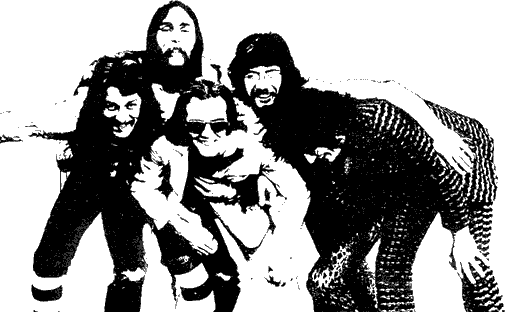
Ariel
circa 1973 - Mike Rudd, Bill Putt, Nigel Macara,
John Mills and Tim Gaze
|
| A
Strange Fantastic Dream
-
Ariel
The
music was fantastic. Mike Rudd
was strange. Still is. Who else could have
written Confessions of a Psychopathic
Cowpoke?
"I like to mess around with strangers,"
drawls Rudd, "Strangers bein' the way
they are." What happens to Rudd's strangers
is unpublishable.
Ariel was to explore Rudd's progressive
rock ambitions and this was their extraordinary
first step.
Tim Gaze was on board with Rudd's mate Bill
Putt in perhaps their most powerful combination.
At the same time Led Zeppelin chanced their
arm with reggae (D'yer Maker),
Ariel showed precisely how it is done with
the exuberant Jamaican Farewell.
Gaze's explosive riff and Rudd's seldom
examined lyrics set up a great rock moment.
Pete Best - Sunday Herald Sun Sept.
2002 |
|
| A
Strange Fantastic Dream
and
Rock & Roll Scars -
Ariel
Music-lovers looking to update vinyl
copies of their favourite albums with CD
re-releases can eventually obtain even the
most obscure international titles via countless
overseas catalogues or the Net.
Due to the longtime negligence of some Australian
record companies, many local albums- particularly
those recorded during the '60S and '70s
when gifted writers arid performers were
creating innovative ground-breaking music
- are impossible to obtain. One of many
unique talents to experience the frustration
of this neglect of our record history is
Mike Rudd.
None of the fine Spectrum/Murtceps albums
released by EMI records between 1971 and
1973 are available in their original form.
Unfortunately Rudd suffered a similar fate
with his next band Ariel: their first two
albums, both released in 1973 by EMI, were
eventually made redundant. However, due
to the tenacity of Rudd and his management,
master tapes were eventually located of
A Strange Fantastic Dream and its follow-up
Rock & Roll Scars, both available on
Rare Vision, the label of Rudd and longtime
collaborator Bill Putt. The uncompromising,
adventurous songwriting that was so admired
in Rudd's Spectrum material caused a furore
when the first Ariel album hit record stores.
Three tracks were immediately banned from
radio play, the Spectrum-ish 'Chicken Shit
(I Need a Fix of Chicken Shit), a country-styled
'Confessions of a Psychopathic Cowpoke'
(a story of mayhem and necrophilia), and
'Miracle Man' written by guitarist Tim Gaze
(ex-Tamam Shud and Kahvas Jute) that apparently
offended some members of the medical profession.
Gaze was one of two musicians (drummer Nigel
Macara was the other) recruited by Rudd
to join himself and former Spectrum members
Putt (bass guitar) and keyboard player John
Mills in a line-up that would hopefully
achieve the international success that eluded
his former band. The album's first single,
a rare Rudd collaboration (he completed
Gaze's original idea) was the riffy, rocking
'Jamaican Farewell', winner of the pre-ARIA
FACB Award for Single of the Year and Rudd's
biggest hit since 'I’ll Be Gone'.
The solid rhythm provided by Putt and Macara,
plus Mills' array of keyboards including
the newly acquired Mini-Moog, were used
to great effect on 'Garden of the Frenzied
Cortinas', the album's longest and most
Spectrum-like track. The interplay between
Rudd's fingerstyle electric guitar and Gaze's
blazing lead, in addition to Rudd's innovative
arrangements and quirky lyrics, made for
an innovative, accessible album that made
the national Top 10 and garnered praise
from legendary English DJ John Peel.
His endorsement resulted in EMI arranging
for the band to record their next album
at Abbey Road Studios in London. Only problem
was, the band had broken up!
Gaze, Macara and Mills were out, leaving
Rudd and Putt to pick up the pieces, which
they promptly did, hiring ex-Dingoes drummer
John Lee and guitarist Harvey James (ex-
Mississippi) for Ariel, Mk ll.
Buoyed by their pending trip to the UK,
the four musicians convened in Sydney to
record 'The"Jellabad Mutant', Rudd's
projected science-fiction concept album,
in preparation for the demos to be polished
at Abbey Road prior to the album's release.
What release? EMI Australia rejected the
demos as 'unsuitable' on the eve of Ariel's
arrival in London.
So here they were, booked into Abbey Road
(oh yeah, EMI had also slashed their budget,
giving them one week to record and one more
to mix) with nothing new to record and with
a band that was barely months old.
As he had done many times before and would
continue to do throughout his 40-year career,
Rudd rose to the occasion delivering the
vibrant 'Rock & Roll Scars', made up
of re-recorded versions of Spectrum and
early Ariel material with three new songs
he'd somehow had time to write.
Blessed with an exceptional lead guitarist
in James, Rudd arranged many of the songs
to accommodate his first keyboardless band.
'Keep on Dancing' (a Top 20 single in Australia),
'Rock & Roll Scars', 'Real Meanie' and
'Men in Grey Raincoats' are brilliantly
conceived guitar, bass and drums rock'n'roll,
full of diving rhythms, enthusiastic vocals
and fiery guitar solos.
Of the older songs, Spectrum's 'I'll Be
Gone', with its Tommy Steele meets the Goons
intro, 'Launching Place Part ll' (Part I
was 'I'll Be Gone' B side), 'We Are Indelible'
and 'What the World Needs (Is a New Pair
of Sox)' fit comfortably into their new
guise.
What a treat to be able to revisit these
two essential albums, re-mastered with additional
sleeve notes from Ariel's original producer
Peter Dawkins.
Also available is the long lost 'Jellabad
Mutant' album recently released on Rare
Vision.
Billy Pinnell - Rhythms magazine March
2004
|
|
| The
Jellabad Mutant -
Ariel
The cover of the fresh issue of Jellabad.
That’s Oliver Leonard in the starring
role, about to unleash wild mutant mayhem
with his white Strat! He also provided some
spaced-out artwork for the CD release
As part of an on-going series of compact
disc reissues of seminal Rudd/Putt-related
albums, comes The Jellabad Mutant, which
was never officially released before now.
Lovingly remastered from the 1974 Peter
Dawkins-produced demos, recorded at EMI
Sydney; the integrity and sound quality
of these rudimentary tapes has been brilliantly
captured for the digital medium by Martin
Pullan of Edensound in Melbourne. Martin
also worked sonic wonders for the previous
two Ariel CD reissues, A Strange Fantastic
Dream and Rock & Roll Scars.
There are also a couple of bonus tracks
– a “Mutant Medley” taken
from a live-to-air Double J broadcast from
May 1976 as well as both sides of a 1975
single produced by respected musician-producer
Rod Coe and originally released on EMI’s
“progressive” Harvest imprint.
These two latter tracks – “I’ll
Take You High” and “I Can’t
Say What I Mean” – while not
being part of the Jellabad story proper,
represent the only officially-released recordings
of the classic, uber-hot five-piece Ariel,
and display the “3-guitar attack”
that Mike and Bill enthuse about in our
interview. It’s perhaps a measure
of EMI’s cavalier treatment of the
band by this stage that master tapes of
these two songs could not be located for
the reissue! At Mike’s request, your
humble writer was able to supply his vinyl
copy of the single. But after Pullan waved
his magic wand over them, the listener would
never know that these tracks were sourced
from a crackly 45!
The Jellabad suite itself – vaguely
inspired by the Christmas ’73 coming
of Kahoutek’s comet, with a tincture
of The Day Of The Triffids for good measure
– concerns the arrival in a refrigerated
capsule at the fictitious Victorian town
of Jellabad, of an abstractly-drawn mutant
figure who seeks to become part of the human
race. Shades of Superman and similar pop-sci-fi
tales, but in Rudd’s deft compositional
hands, this story’s different.
The mutant gets adopted by an elderly, childless
couple, assumes humanoid form and sets about
implementing its sinister plans. Without
giving too much of the labyrinthine plot
away, the mutant eventually does away with
his adoptive parents, but not before entering
the brain-space of a hapless down-at-heel
musician (by plying him with a “pot
of tea”).
The opera’s theme is compellingly
drawn by Rudd’s typically perverse
lyrics – by turns oblique, poignant,
sad, outright hilarious and sometimes endearingly
puerile (witness “The Hospital”).
Supported by some fine ensemble playing
that alternately rocks (“The Train”,
“Neo-existentialist Greens/Medicine
Man/The Letter”), waxes gentle (“Cinematic
Sandwiches”) and just plain swings
like a mutha (my favourite, “The Funeral”);
it seems ludicrously criminal in retrospect
that this body of work was rejected by the
then-powers-that-be.
Mike Rudd laments in the liner notes to
the Mutant CD:
It’s interesting to speculate
what might have happened had we been allowed
to proceed with the
Mutant with an intact budget (EMI slashed
the budget for Rock & Roll Scars adding
to the
pressure) and with time to reflect and be
creative with the raw material you hear
in the demos.
I regret I didn’t go into bat for
it at the time. We had a fabulous opportunity
with the best
technical assistance any band could have
wanted. But I didn’t sell the dream,
even to myself.
Lament ye no longer, punters, for now we
have the opportunity to hear what might
have been, and it’s as worthy as anything
in the Ariel canon. Seek it out and “use
your imagination”!
© 2003 Paul Culnane for Foffle
Zine |
|
| back
to the top
|
| Chants
R&B - Live '66: The Stage Door Tapes
I'm defying my own policy here and
reviewing this from an advance cassette,
but hopefully it'll exist on vinyl by the
time you read this, 'cos you gotta HEAR
this for yourselves. It's is one of the
WILDEST, most exciting LIVE albums I've
ever heard - like Kick Out the Jams, James
Brown Live at The Apollo and Five Live Yardbirds
rolled into one big, sweaty ball of pure
Punk R&B ENERGY. OK, OK, I'm not trying
to make a case that this here LP is as SEMINAL
as any of those esteemed pieces; just that
on one hot, muggy night in October 1966
at The Stage Door in Christchurch, New Zealand,
a group called Chants R&B tapped into
that same power source and by some miracle
it was captured undiluted on tape.
Some of this material was already released
on the Stage Door Witchdoctors album of
a couple of years back, but most of these
16 tracks appear for the first time (and
a couple of the live tracks from Witchdoctors
aren't on here). The sound quality is crude,
but NOT cruddy, muddy or bloody awful, in
fact it probably sounds a lot like it sounded
if you were there that night: LOUD, raw
and slightly unbalanced.
Their versions of songs like the "Land
of 1000 Dances," "1'll Go Crazy"
and "Hold On, I'm Coming" are
hotwired to crazed extremes, full of screaming,
fighting, shouting vocals with instruments
wailing and colliding in all directions
without ever losing that vital groove.
Like hungry cannibals they savage the Graham
Bond Organization's "Train Time"
and the Poets' "That's the Way It's
Got To Be," and their searing treatment
of "Don't Bring Me Down" is the
greatest Pretty Things cover version I've
ever heard. They even manage to turn the
Four Tops' "Baby I Need Your Loving"
into a tribal death stomp.
When bassist Martin Correr (sic) ripped
into the superfast intro to the Artwoods'
"I Feel Good" I swore for a second
it was the Damned's "Neat Neat Neat"
if that gives you any idea of what I'm trying
to communicate here in my overamped, inarticulate
way.
You probably can't afford to buy everything
that gets a positive review in Ugly Things,
but make sure you beg, borrow or steal enough
loot to bag THIS beauty, y'hear?
(MS) Ugly Things |
|
|
|
| |
|
|
| |
|
|
|



