| |
| Disclaimer
For
some curious reason, Whammo has changed
address and dropped almost any reference
to Spectrum, The Indelible Murtceps and
Ariel etc.
Thanks to Martin Finnegan for pointing this
nasty turn of events out to me - I shall
ring Ian McFarlane and see what the story
is. Fortunately the Milesago website
steadfastly maintains the truth, the whole
truth, and nothing but the truth - so Spectrum
(and Ariel) still feature prominently in
the context of the history of Oz Rock. I'll
eventually get round to writing some idealised
version of what really happened, but you'll
get an impression of what's occurred in
some sort of order by referring to the Milesago
links below.. (Be patient - I can't get
you directly to the page you want - you'll
have to find it on the menu). You should
have a look at the Spectrum reference on
Ed Nimmervoll's Howlspace
site too.
Anyway, I think you'll enjoy the pics, some
published for the first time. And, while
you're here, why don't you check out The
Legend.. |
|
| |
The
life and times of Nicky Campbell
17.7.06 - I think the first time Bill and
I saw Nicky Campbell was at the White Elephant
(the Broady Town Hall). We'd never seen a
roadie before and so were utterly astonished
to see this mucular young bloke with the boofy
hairdo repeatedly bustling through the audience
with various pieces of stage equipment balanced
on his shoulders. I think he was working for
Larry's Rebels (NZ) at that stage 'cause that's
when we first came across Mal Logan as well.
Needless to say we liked the concept of somebody
dedicated to carrying around our equipment
for us, so we soon invited Nicky to join our
team, and he worked for us for quite a few
years before we parted company, probably not
because of musical differences, but I don't
really remember the circumstances. Anyhow
it was good to hear from him and to find out
what he's been up to while Bill and I have
been so singularly preoccupied.
Well, my favourite Spectrum memories
would be the university campus tour we did
with Daddy Cool (The Aquarius Tour). The T.F.Much
ballroom gigs were unique - I have actually
had a massage from an older lady who lives
up here who used to go to all the T.F.Much*
gigs and says she remembers the great gigs
that they were, and the party atmosphere that
was captured by all the crazy hippies on the
night. You never knew what would happen at
those gigs.
I also have fond memories of the Monsalvat
gigs and the Myponga gig in Adelaide. Also
the gigs for Alex Innocenti the wog hippy
in high heeled boots with the fuzzy hair who
ran the local blues club.
read more
*And see shots of Nicky and the infamous Transit
- how did we do that? |
|
|
|
| The
Spectrum and The Indelible
Murtceps stories
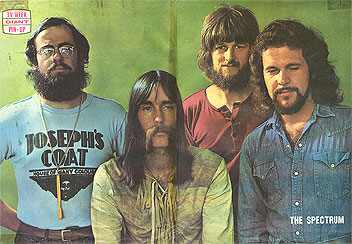
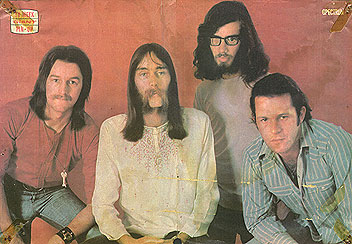
As readers will have guessed, Spectrum
is one our favourite Australian bands, and
one of our missions here at MILESAGO is
to prosecute the cause of this outstanding
group. During their brief but illustrious
career Spectrum were in the vanguard of
progressive rock in Australia, and they
left a legacy of innovative and imaginative
music, too little of which is currently
available on CD.
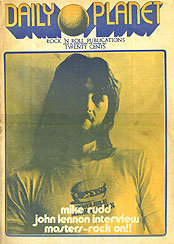
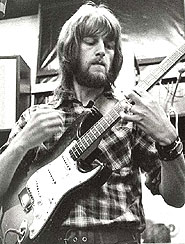
The central figure in Spectrum was singer/songwriter/guitarist
Mike Rudd, one of the many outstanding expatriate
NZ performers who have contributed so much
to the Australian music scene. Mike arrived
in Australia in 1966 as rhythm guitarist
for the NZ group Chants R&B. [For the
full history of this great band, please
visit the Chants R&B page on Bruce Sergent's
excellent New Zealand Music of the 60's
and 70's website.]
Chants only lasted a short time after they
arrived in Australia, but Mike remained
in Melbourne, where he soon teamed up with
young singer/songwriter Ross Wilson and
guitarist Ross Hannaford. Their first band
The Pink Finks (which had also just broken
up) worked in a similar vein to Chants,
and had already had some local chart success
in Melbourne. Mike was invited to be the
bass player in a later lineup of their next
band, the short-lived but legendary Party
Machine (1967-69). This was followed by
the more experimentally-oriented Sons of
The Vegetal Mother (1969-71)
read more
See Mike & Bill's historical interview
with Bill
Brown at the 2010 Wagga Wagga
Jazz & Blues Festival
Dave Graney's bro' Phil, and Melbourne
identity Bruce Milne, share some thoughts
of their impressions of the early careers
of Spectrum and Ariel (reproduced without
permission from Dave Graney - but I'm sure
he won't mind..)
check
them out |
|
| |
| back
to the top
|
| The
Ariel and the Instant
Replay stories
The original lineup of Ariel
was a genuine 'supergroup', combining key
members from two of Australia's leading
progressive bands of the period: Rudd, Putt
and Mills hailed from Melbourne's legendary
Spectrum, Gaze and Macara from Spectrum's
esteemed Sydney peers Tamam Shud. Lead guitarist
Tim Gaze, regarded as one of the hottest
players on the scene, had also joined Shud
at just 16 and by the time he joined Ariel
he had also been a member of Kahvas Jute,
and played on their only album, the brilliant
Wide Open.
Like its predecessor, Ariel was primarily
a vehicle for the talents and vision of
singer, songwriter and guitarist Mike Rudd,
and his longtime bass-player and musical
partner, Bill Putt. Like Spectrum, the band
began strongly, but lineup changes, record
company problems and the changing nature
of music in the mid-70s meant that they
never achieved the level of success they
deserved, and Ariel proved to be Mike Rudd's
last really high-profile outfit, although
he remains one of the most respected figures
in the music scene. read
more |
|
| |
| back
to the top
|
|
The
Mike Rudd & the Heaters, WHY,
The Living Legends Blues Band, Nuclear
Dog, The Mike Rudd Quintet, No. 9 and
The Fez stories
In July 1979, Rudd changed the band's name
to Mike Rudd and the Heaters. The band played
a mix of pub rock and pop (with quasi-new
wave overtones) and was popular on the Melbourne
scene. The band signed to Mushroom Records
and issued its debut single, `Australian
Girl'/`Talking to the TV' (February 1980).
In June 1980, The Heaters line-up became
Rudd, Putt, Tony Fossey (keyboards) and
Robert Dillon (drums; ex-Kid Gloves). The
band's debut album, The Unrealist (January
1982), produced three singles, `I'm an Animal'/`Head
Job' (October 1981), `Laser Love'/ `Keeping
Your Distance' (January 1982) and `Love
Comes and Goes'/`Models' (April 1982). The
records were not successful and The Heaters
broke up in June 1982.
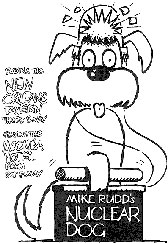
See more on Nuclear
Dog and The
Fez |
|
| |
| back
to the top |
| The
Party Machine and
The Sons of the Vegetal Mother stories
The enterprising Ross
Wilson
was the driving force behind the innovative
Party Machine. Wilson and Ross Hannaford
first worked together in Melbourne teenage
R&B outfit The Pink Finks. At the beginning
of 1967, the two Rosses formed the altogether
more radical The Party Machine. Chris Kinman
replaced original bass player Joe Gorski
not long after formation.
In June, Mike Edwards left to join The Ram
Jam Big Band and Kinman also left. His place
was taken by ex-Chants R&B guitarist
Mike Rudd, who switched to bass. For the
material he was writing with The Party Machine,
Wilson drew on Frank Zappa and Howlin' Wolf
for inspiration. The band issued the now
impossibly rare single `You've All Gotta
Go'/`Gentle Art' on EMI/Columbia in early
1969. The Party Machine found notoriety
rather than success, in particular when
the Victorian Vice Squad deemed the band's
printed
songbook (which
contained such choice Wilson-penned songs
as `I Don't Believe All Your Kids Should
Be Virgins') to be obscene and seditious.
|
|
| |
|
|



.jpg)
-sepia.jpg)